It's the time of year when it gets chilly after dark. When people want to tell a coworker or friend "take a jacket with you" in English, many just say "Bring a jacket." and leave it there. The sentence is correct. But said quickly and bluntly, it can sound like an order to the listener. We correct this one often in our small-group classes.
One phrase that turns an order into a suggestion
Put "You might want to" in front. Taken word for word it means "you may want to," but in real use it's a soft suggestion, closer to "it'd be a good idea to."
- You might want to bring a light jacket tonight. (It'd be a good idea to bring a light jacket tonight.)
- You might want to take an umbrella. (It'd be a good idea to take an umbrella.)
- You might want to leave a little earlier. (It'd be a good idea to leave a little earlier.)
When you say it, run "might want to" together so it sounds like "my-wanna." Reading it one word at a time actually sounds less natural.
Add one sentence with a reason and the conversation keeps going
If you give a reason after the suggestion, it's easier for the other person to respond.
A: It gets chilly after sunset. You might want to bring a light jacket.
B: Good idea. What are you wearing?
A: A T-shirt and a cardigan.
Accept the advice with "Good idea." and ask about the other person's clothes with "What are you wearing?" and the next line comes naturally. In class, we always have students say these two lines out loud to each other.
Four sentences for work
Use the same pattern at work and it becomes a gentle way to pass on instructions.
| Situation | English |
|---|---|
| Asking someone to check the numbers | You might want to double-check the numbers. |
| Suggesting a follow-up email | You might want to send a follow-up email. |
| Backing up files | You might want to back up your files. |
| Raising something at a meeting | You might want to bring that up at the meeting. |
Use these with your boss or coworkers instead of "Do this." The message is the same, but it lands very differently.
How do you ask for something in English without sounding bossy?
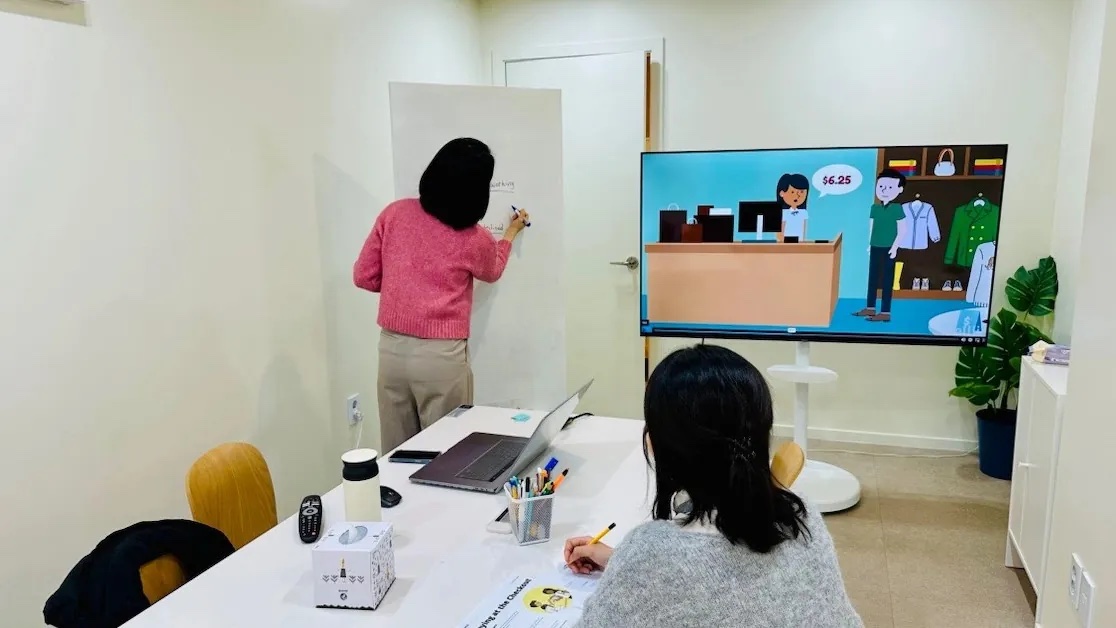
At Yium English Bundang, we practice suggestion patterns that start with "You might want to" in our beginner and elementary small groups. Classes have up to 5 students, 2–3 on average, so each person speaks many times during the hour, and the instructor corrects tone and pronunciation on the spot.
When can working professionals take these classes?
We have weekday evening group classes at 6 p.m. and 7 p.m. We're 11m from Exit 3 of Migeum Station, so you can drop by on your way home from work. For 1:1 lessons, you choose a time on weekdays between 7 a.m. and 10 p.m.